Updated 15 July 2025. We comply with the safety policy of our fiscal sponsor, First Parish in Cohasset. We provide mandatory child protection training for all our volunteer staff. Our sponsor conducts criminal background checks on all staff over age 18.
The safety policies below have been instituted to comply with licensing requirements for day camps.
Camp health care policy
Medical release and information form: All participants under the age of 18 must have a medical release and information form signed by parents or guardians, to allow medical treatment in case of emergency. These forms will also have any necessary health records for the camper (allergies, known health issues, etc.). Medical release and information forms must be turned in no later than drop-off on the first day of camp.
Tick and mosquito safety: We recommend sending your camper with your preferred insect repellent. The camp will have a supply of DEET repellent. We can help apply spray repellent (no touch), avoiding bare skin. All insect repellent must be applied away from other campers, under supervision of camp staff. We’ll do daily visual tick checks of exposed skin and outer clothing. As with any outdoor activity, we recommend that parents/guardians do full tick checks at home as well.
Illness during camp: If your child should become mildly ill while at camp, they will be brought to the room designated as the infirmary to be examined by the camp health coordinator. The health coordinator will determine whether parents/guardians should be contacted, or if the camper should remain at the infirmary until feeling better, or if they should return to camp activities. (See also COVID safety below.)
COVID safety: All camp staff and all campers are required to have COVID immunization. If your child is experiencing symptoms of COVID, please do not send them to camp. If a child develops COVID symptoms during the camp day, we’ll isolate them and contact parents/guardians for an early pick-up.
Health emergencies: In case of a health emergency, camp staff and/or the health coordinator will place the emergency call to first responders. Staff will then immediately call parents/guardians. Camp staff will give the camper’s medical release and information form to the EMT team and will stay with the camper until the camper is transported to the hospital. In a life-threatening situation, the first staff person on the scene will stay with the camper and send someone to call for an ambulance. If a camper is transported to the hospital, an adult staffer will also go to the hospital to remain with the camper until a parent/guardian arrives.
Child protection policy
We follow the child protection policy of our sponsor, First Parish in Cohasset, including CORI checks for all adult staff, “two-deep rule,” and ongoing supervision of all staff. There will be at least one mandated reporter on site who has completed state-approved 51a training through Middlesex Children’s Advocacy Center. For reporting suspected abuse, we will follow state law.
In addition, to protect campers’ privacy and to adhere to our media release permission form, we ask that no videography or camera usage is allowed amongst campers. Phone and screen usage is also not permitted unless during an emergency or when a camper must reach a guardian/parent.
Contingency plans
Children who are registered and on the camp roll but fail to arrive for a given day’s activities: 15 minutes after the stated start of camp, the camp director or other adult counselor will call the parent/guardian cell phone on file to determine if and when the camper will be present. If unable to reach the parent/guardian, the camper will be assumed to be absent that day.
Children who fail to arrive at the point of pickup following a given day’s activities: Parents will be notified immediately. Camp staff responsible for that camper’s age group will state the last time the camper was definitely with the group. At least two adult camp staff will stay with other campers, while at least two adult staff begin searching for the camper at the last known location.
Children who arrive at camp without having registered and without prior notification will not be admitted to camp.
Discipline policy and behavioral guidelines
Behavior guidelines
At Ecojustice Camp, we believe that people can have a positive impact on each other. We believe in the inherent worth and dignity of all human beings. We also believe in treating the entire interdependent web of existence, including plants and animals, with respect. We’re a multiracial, LGBTQIA+-friendly camp. Our behavior guidelines begin with this principle of mutual respect among campers, camp staff, and the natural world.
Every participant in the camp takes responsibility for their own actions. We will treat each other with respect, and we treat the natural world with respect. We care for each other, and we care for the natural world. In case of any lapses, staff will address them in an age-appropriate way (see Discipline Policy).
Smartphone and cell phone use: Campers are not allowed to use smartphones or cell phones during camp, with the exception of contacting parents. Campers are not allowed to take photos with their phones, to protect the privacy of families who do not want photos of their children.
Discipline policy
In case of any lapses in the behavior guidelines, staff will address them in an age-appropriate way. When a camper does not follow the behavior guidelines, we will follow these steps to help the camper comply with the behavior guidelines.
First, staff will redirect the camper to more appropriate behavior.
Second, if inappropriate behavior continues, the camper will be reminded of behavior guidelines and camp rules, and the camper will be asked to help decide on action steps to correct their behavior.
Third, if a camper’s behavior still does not meet the camp guidelines, they will be referred to the camp director to talk about how the camper can follow behavior guidelines.
Finally, if inappropriate behavior continues, the camper may be dismissed from camp. Camp fees are not refunded if a camper is dismissed due to behavioral issues.
As a matter of mutual respect, and to comply with state law, the following forms of discipline are not allowed. Corporal punishment, including spanking, is prohibited. No camper shall be subjected to cruel or severe punishment, humiliation, or verbal abuse. No camper shall be denied food, water or shelter. No child shall be punished for soiling, wetting. or not using the toilet. The above is a matter of common sense, and it’s also a key part of our discipline policy.
The following behaviors are specifically prohibited, and will result in disciplinary action as outlined above:
Refusal to follow camp rules, including the behavioral guidelines
Any use of tobacco, alcohol, or illegal drugs
Leaving any program without staff permission
Teasing, bullying, or fighting
Disrupting a program, or endangering anyone else’s safety or health
Emergency and disaster plan
Fire drill: will be conducted on the first day of camp.
Weather disasters: Camp staff will monitor National Weather Service watches and warnings. In case of such weather events (e.g., tornado watch/warning or hurricane watch/warning), field trips will be canceled. In case of extreme heat, activities will be limited and/or held indoors or in shade. Camp may be canceled at the discretion of the directors for the most severe weather events (e.g., hurricanes).
Camp staff will monitor National Weather Service heat index forecasts, and government Air Quality Index (AQI) forecasts. In case of heat index of 100 or over, or AQI of 100 or over, outdoor activities will remain low-key. Extremely high heat index or AQI may result in activities moved indoors into air-conditioned rooms, and field trips may be canceled.
Parents/guardians will be notified upon any change of plans (e.g., field trip cancelation) due to weather events.
Evacuation: If campers need to be evacuated immediately due to a natural disaster, camp staff will follow the direction of local and/or state authorities. If transportation is needed, vehicles for field trips will be used.
Drinking water: The camp uses Town of Cohasset water. If the Town determines that the water supply has been compromised, the camp will follow the direction of local authorities regarding water supply.
Field trips
A written itinerary will be established before departure for all field trips, and parents will be provided with this itinerary no later than drop-off time the day of the field trip. If there are changes to the itinerary, parents/guardians will be notified. One adult staffer will be designated Health Care Supervisor for each field trip. The Health Care Supervisor or at least one adult staffer will have current Red Cross First Aid certification. The Health Care Supervisor for the field trip will carry a backpack with health records and medications, along with a first aid kit, medical release and information forms, and any medications.
Field Trip Contingency Plans:
In case of a lost camper, parents will be notified immediately. Camp staff responsible for that camper’s age group will state the last time the camper was definitely with the group. At least two adult camp staff will stay with other campers, while at least two adult staff begin searching for the camper at the last known location.
In case of illness or injury, two adult staffers will remain with the ill or injured camper. For illness, one of those adults will immediately contact the parents/guardians, and emergency personnel in case of illness requiring immediate medical treatment. For injury, one of those adults will immediately contact the parents/guardians, and emergency personnel in case of injury requiring immediate medical treatment. The two adult staffers will decide with the parent/guardian how the camper will be returned to the care of the parent/guardian.
In case of natural disaster: Camp staff will monitor National Weather Service watches and warnings. In case of such weather events (e.g., tornado watch/warning or hurricane watch/warning), field trips will be canceled.
Lost camper policy
In case of a lost camper, parents will be notified immediately. Camp staff responsible for that camper’s age group will state the last time the camper was definitely with the group. At least two adult camp staff will stay with other campers, while at least two adult staff begin searching for the camper at the last known location. After 30 minutes, if the camper is still lost, we will notify emergency services (call 911).
Tent policy
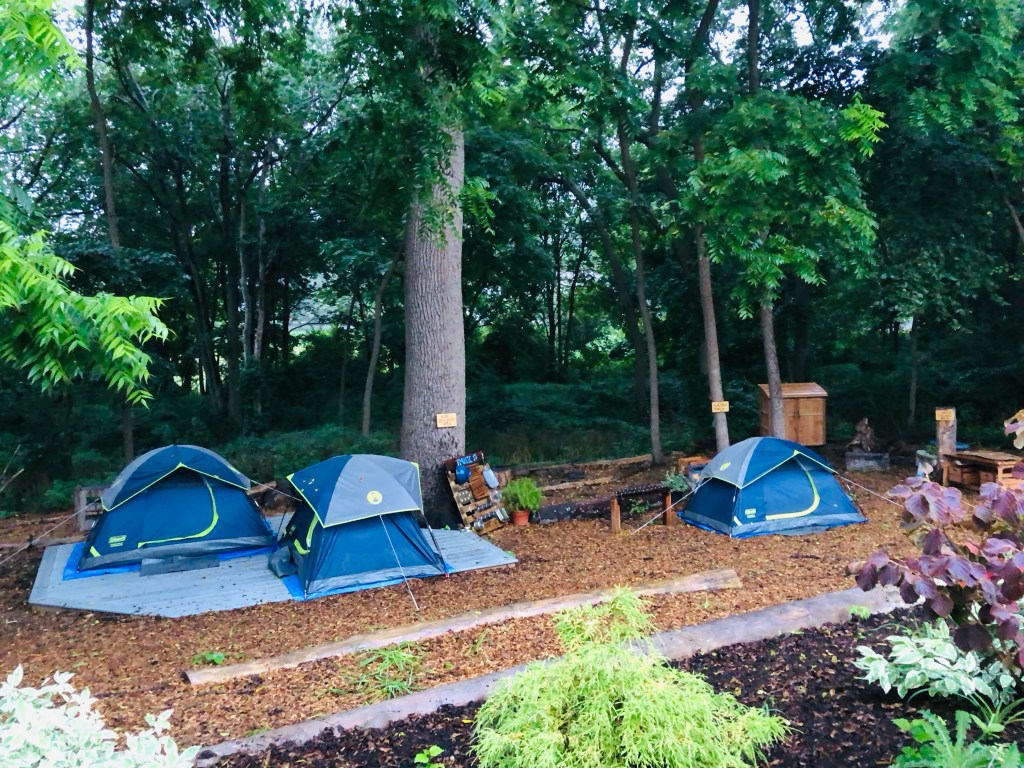
As of May, 2024, the Commonwealth of Massachusetts requires us to have parents sign off on tent assignments. Even where your child will be sharing a tent with a sibling, the tent assignment form must be completed.
Traffic control policy
There is no vehicular traffic allowed through the camp grounds while camp is in session. For pick up and drop off, parents/guardians must park on the street in legal parking places around Cohasset Common, and come to the camp to sign in or sign out their camper(s).
Unrecognized persons policy
Camp staff will be trained on the following Unrecognized Persons Policy.
If an unrecognized person enters the camp’s grounds, camp staff will:
1. Immediately ask their purpose for being at camp, and as needed help them clarify the location they are seeking.
2. If they are looking for the camp, confirm that they have authorization (for example, from a parent/guardian) to be at the camp.
3a. If the person doesn’t have authorization, explain politely that they are not permitted on camp grounds, and make sure they leave the premises. Then inform one of the co-directors immediately.
3b. If the person does have authorization, explain that they must check in with one of the camp’s co-directors, and make sure they find one of the co-directors.
If the person refuses to leave the camp premises, becomes aggressive or violent, or attempts to remove a child without authorization, a camp co-director (or their designee) will:
1. Call 911 to report the incident.
2. Alert camp staff to the situation, move campers to a secure location (e.g., indoors) and secure the premises.
3. Make sure no one enters or exits the premises until police have arrived.
4. Provide a point of main point of contact for all concerned (staff, parents/guardians, police).
5. When resolved, write a detailed report of the incident, including date, time, person(s) involved, and resolution
 Ecojustice Camp